
Blog
Revenue Alignment:How Marketing and Sales Build Predictable Pipeline Together
In high-performing B2B organizations, marketing and sales are not separate departments.
They are revenue partners.
Yet in many companies, tension persists:
- Marketing reports MQL growth
- Sales questions lead quality
- Follow-up delays occur
- Forecasts fluctuate
- Revenue targets become difficult to predict
The issue isn’t effort.
It’s alignment.
Predictable pipeline doesn’t come from more campaigns.
It comes from shared accountability.
The Cost of Misalignment
When marketing and sales operate independently, friction forms.
Marketing optimizes for:
- Lead volume
- Cost per acquisition
- Engagement metrics
Sales optimizes for:
- Opportunity value
- Close rates
- Deal velocity
- Revenue attainment
If KPIs differ, priorities diverge.
This leads to:
- Rejected leads
- Delayed outreach
- Poor qualification feedback
- Blame cycles
Pipeline becomes inconsistent.
Trust erodes.
Revenue suffers.
The Shift from Lead Ownership to Revenue Ownership
Modern demand generation requires a structural shift.
Instead of asking:
“How many leads did marketing generate?”
Revenue teams ask:
“How much qualified pipeline did we create together?”
This reframing aligns both sides around:
- SQL conversion
- Opportunity creation
- Pipeline velocity
- Influenced revenue
Success becomes shared.
Building a Revenue-Aligned Framework
High-performance B2B organizations implement five alignment principles.
1️⃣ Shared Qualification Standards
Alignment begins with agreement.
Both teams define:
- ICP criteria
- Buying authority requirements
- Initiative validation
- Timeline expectations
- Sales-readiness benchmarks
This removes ambiguity.
Marketing understands what qualifies.
Sales understands what to expect.
2️⃣ Service-Level Agreements (SLAs)
Speed impacts conversion.
Revenue-aligned teams define:
- Follow-up timelines
- Feedback requirements
- Data completion standards
- Handoff processes
For example:
- Sales commits to responding within a defined window
- Marketing commits to delivering validated leads
Accountability strengthens performance.
3️⃣ Transparent Data Visibility
Both teams must share insight.
Integrated CRM and marketing automation systems enable:
- Engagement tracking
- Account-level activity mapping
- Stage progression visibility
- Conversion metrics
Transparency prevents blame.
Data replaces assumptions.
4️⃣ Continuous Feedback Loops
Alignment is not a one-time meeting.
It is ongoing collaboration.
High-performing teams conduct:
- Pipeline review sessions
- Win-loss analysis
- Campaign performance assessments
- Qualification refinement workshops
Feedback improves targeting precision.
Precision improves revenue.
5️⃣ Revenue-Based KPIs
Traditional metrics lose relevance.
Aligned organizations measure:
✔ Sales acceptance rate
✔ Meeting-to-opportunity conversion
✔ Opportunity-to-close ratio
✔ Pipeline contribution
✔ Revenue influence
These metrics reflect business impact.
Not marketing activity.
The Psychology of Alignment
Alignment isn’t only structural — it’s cultural.
When marketing feels disconnected from revenue, campaigns lack commercial discipline.
When sales feels unsupported, follow-up weakens.
But when both teams view themselves as pipeline architects, behavior changes:
- Marketing refines targeting continuously
- Sales engages more proactively
- Qualification standards improve
- Messaging sharpens
The result is performance consistency.
The Role of Technology in Alignment
Technology enables collaboration, but does not create it.
Effective alignment leverages:
- Unified CRM systems
- Integrated marketing automation
- Shared dashboards
- Real-time reporting
But tools require process.
Without process, technology amplifies confusion.
Revenue Alignment in Enterprise Environments
In complex B2B ecosystems, alignment becomes even more critical.
Enterprise demand programs require:
- Account-based coordination
- Buying committee mapping
- Multi-touch orchestration
- SDR collaboration
- Executive-level engagement
Without cross-functional alignment, enterprise pipeline stalls.
With alignment, it accelerates.
The Measurable Impact of Alignment
When marketing and sales operate as a revenue unit:
- Sales acceptance increases
- Conversion improves
- Deal cycles shorten
- Forecast accuracy strengthens
- ROI visibility improves
Revenue becomes predictable.
Predictability drives scale.
From Siloed Activity to Revenue Infrastructure
Revenue alignment transforms:
Campaigns → Coordinated systems
Leads → Opportunities
Metrics → Revenue contribution
Departments → Revenue engine
Alignment is not a soft concept.
It is a structural requirement for sustainable growth.
Final Thought
If pipeline feels inconsistent…
If sales questions marketing quality…
If revenue forecasts fluctuate…
The issue may not be tactics.
It may be alignment.
In modern B2B demand generation:
Marketing generates opportunity.
Sales converts opportunity.
Revenue alignment ensures both succeed.
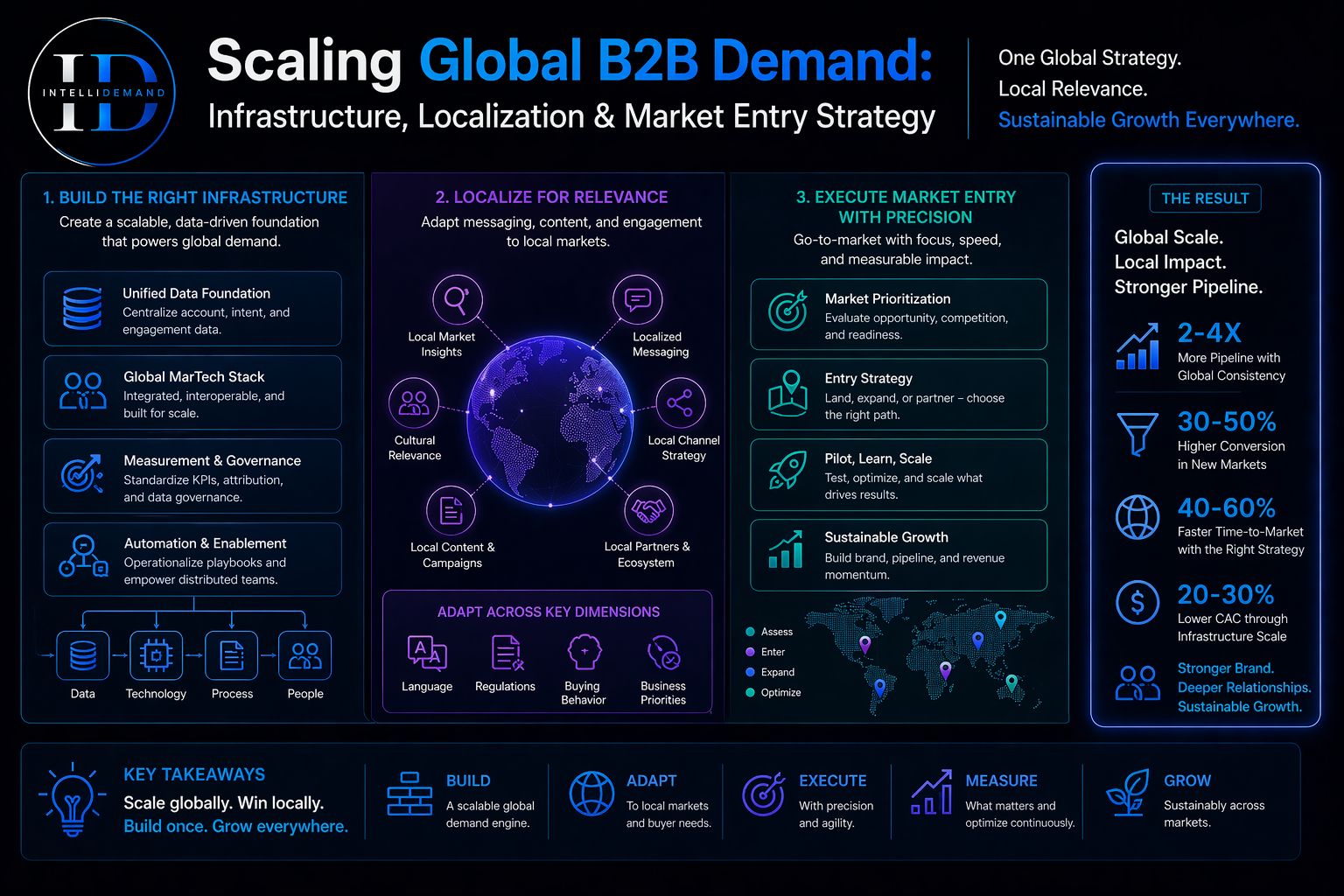
Scaling Global B2B Demand: Infrastructure,
Localization & Market Entry Strategy
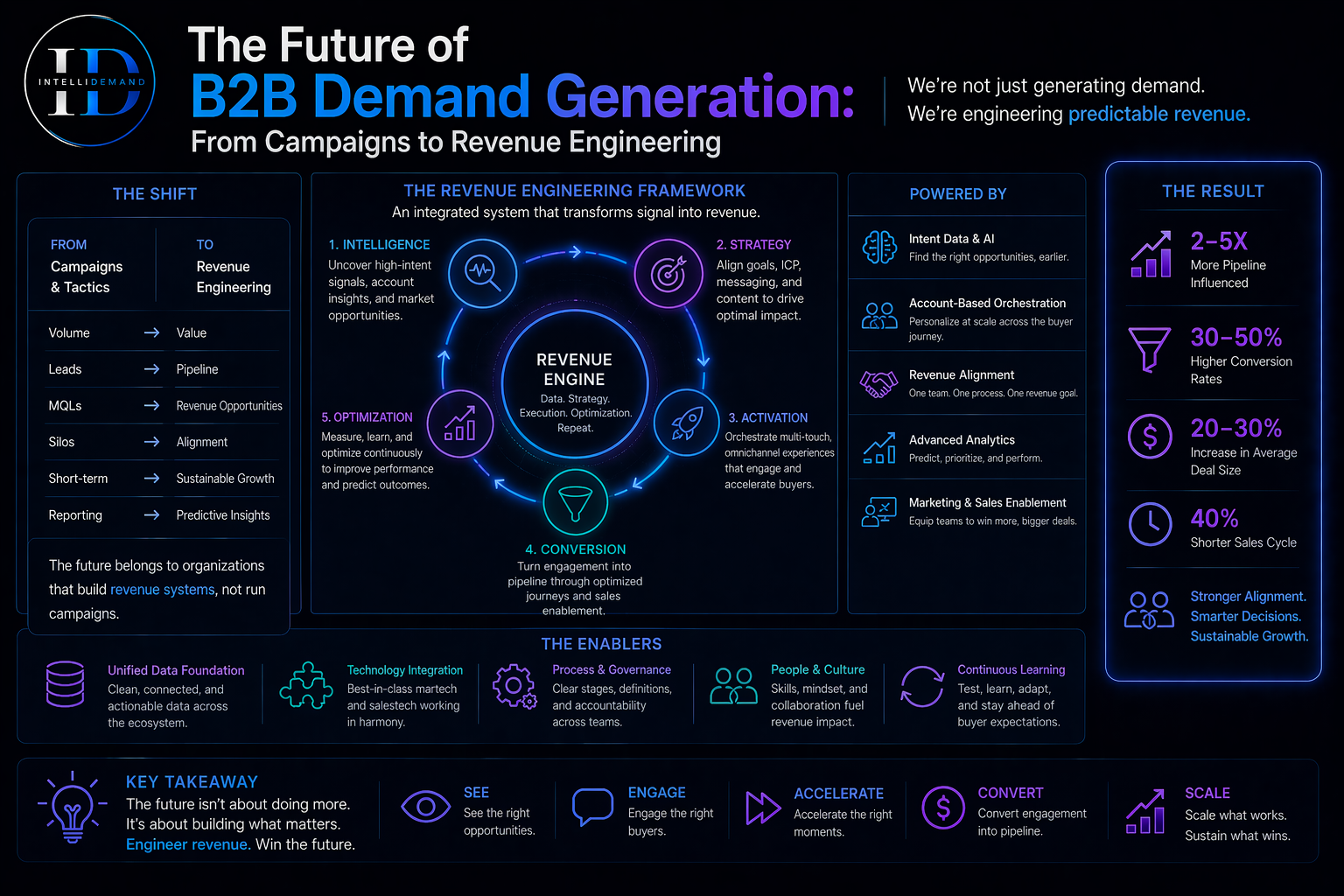
The Future of B2B Demand Generation:
From Campaigns to Revenue Engineering

Copyright © 2026 IntelliDemand