
Blog
Scaling Global B2B Demand:Infrastructure, Localization & Market Entry Strategy
Global expansion is one of the most ambitious growth moves a B2B organization can make.
New markets promise:
- Larger addressable audiences
- Revenue diversification
- Competitive positioning
- Brand authority expansion
But global demand generation is not simply domestic marketing replicated in another geography.
It requires infrastructure.
It requires localization discipline.
And it requires strategic sequencing.
The companies that succeed internationally don’t “expand campaigns.”
They build global revenue systems.
The Myth of Copy-Paste Expansion
Many B2B organizations make a critical mistake when entering new markets:
They duplicate what worked domestically.
Same messaging.
Same targeting criteria.
Same positioning.
Same qualification standards.
But markets differ in:
- Buying behavior
- Cultural nuance
- Regulatory frameworks
- Budget cycles
- Vendor trust dynamics
What converts in one region may underperform in another.
Global growth requires adaptation — not duplication.
Step 1: Market Validation Before Activation
Before launching demand in a new geography, high-performance teams validate:
- Total addressable market (TAM)
- Industry concentration
- Competitive density
- Economic conditions
- Regulatory considerations
- Channel ecosystem presence
Entering a market without structural validation increases risk.
Global expansion must begin with research — not enthusiasm.
Step 2: ICP Recalibration by Region
An Ideal Customer Profile in one country may not translate directly to another.
Recalibration includes:
✔ Revenue band adjustments
✔ Industry maturity analysis
✔ Technographic variation
✔ Procurement structure differences
✔ Decision hierarchy norms
For example:
Some regions require executive buy-in earlier.
Others involve procurement later in the process.
Ignoring these differences slows pipeline progression.
Step 3: Localization Beyond Language
Translation is not localization.
High-performance global demand strategies adapt:
- Messaging tone
- Value positioning
- Proof points
- Industry terminology
- Case study relevance
Buyers respond to contextual authority.
Regional market credibility accelerates trust.
Localization demonstrates understanding.
Understanding builds pipeline.
Step 4: Infrastructure Integration
Global demand scaling requires coordinated infrastructure.
This includes:
- CRM integration across regions
- Marketing automation consistency
- Unified reporting dashboards
- Data compliance management
- Regional SDR alignment
Without centralized infrastructure, global programs fragment.
Fragmentation creates inconsistent performance.
Step 5: Intent & Regional Signal Monitoring
Intent signals vary by geography.
High-performing teams monitor:
- Topic trends by region
- Account-level research activity
- Industry adoption curves
- Competitive brand visibility
This ensures activation aligns with regional buying behavior — not assumptions.
Signal intelligence reduces entry friction.
Step 6: Multi-Touch Market Entry Architecture
Entering a new geography requires layered activation:
✔ Targeted content syndication
✔ Account-based outreach
✔ Regional webinars or thought leadership
✔ SDR contextual follow-up
✔ Retargeting campaigns
Each touchpoint reinforces positioning within that specific market.
Market entry is a coordinated sequence — not a single launch.
Managing Compliance & Data Governance
Global demand generation must consider:
- Data privacy regulations
- Communication consent standards
- Regional marketing laws
- Email compliance frameworks
Failure to align with compliance standards risks reputation and legal exposure.
Structured governance protects global growth.
Sales & Regional Enablement
Global expansion fails when sales enablement lags behind marketing activation.
Revenue-aligned organizations equip regional sales teams with:
- Market intelligence
- Localized messaging assets
- Account-level engagement insights
- Cultural context training
- Competitive positioning frameworks
Demand generation creates awareness.
Sales converts trust.
Both must move in coordination.
Measuring Global Demand Performance
Domestic KPIs may not directly apply internationally.
High-performing teams track:
- Regional pipeline contribution
- Market penetration rate
- Opportunity velocity by geography
- Sales acceptance rates
- Revenue influence across markets
Expansion success is measured in revenue impact — not brand impressions.
The Competitive Advantage of Structured Expansion
When global demand is engineered correctly:
- Entry friction reduces
- Brand credibility accelerates
- Sales cycles stabilize
- Market share grows predictably
When expansion lacks structure:
- Engagement remains shallow
- Conversion lags
- Resources are wasted
- Reputation weakens
Infrastructure determines sustainability.
From Expansion to Revenue Ecosystem
True global demand transformation goes beyond launching campaigns.
It builds:
- Regional account ecosystems
- Channel partner influence
- Industry positioning
- Localized thought leadership
- Long-term revenue infrastructure
Global scaling is not a marketing tactic.
It is a strategic growth initiative.
Final Thought
International expansion is one of the most powerful growth accelerators in B2B.
But it requires:
Research.
Precision.
Localization.
Infrastructure.
Revenue alignment.
Companies that treat global demand as a structured system outperform competitors who rely on duplication.
Because in modern B2B:
Growth is not geographic.
It is architectural.
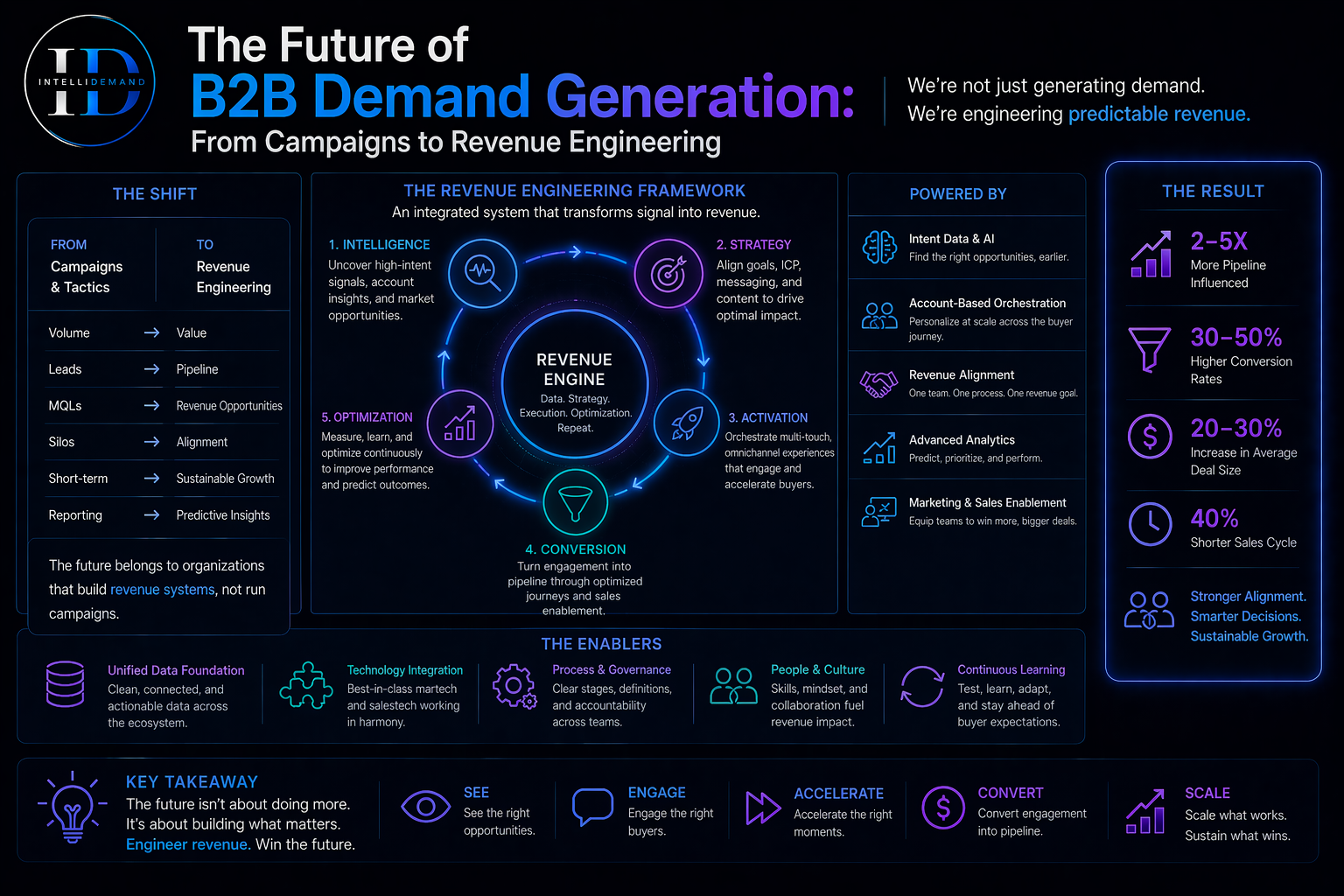
The Future of B2B Demand Generation:
From Campaigns to Revenue Engineering
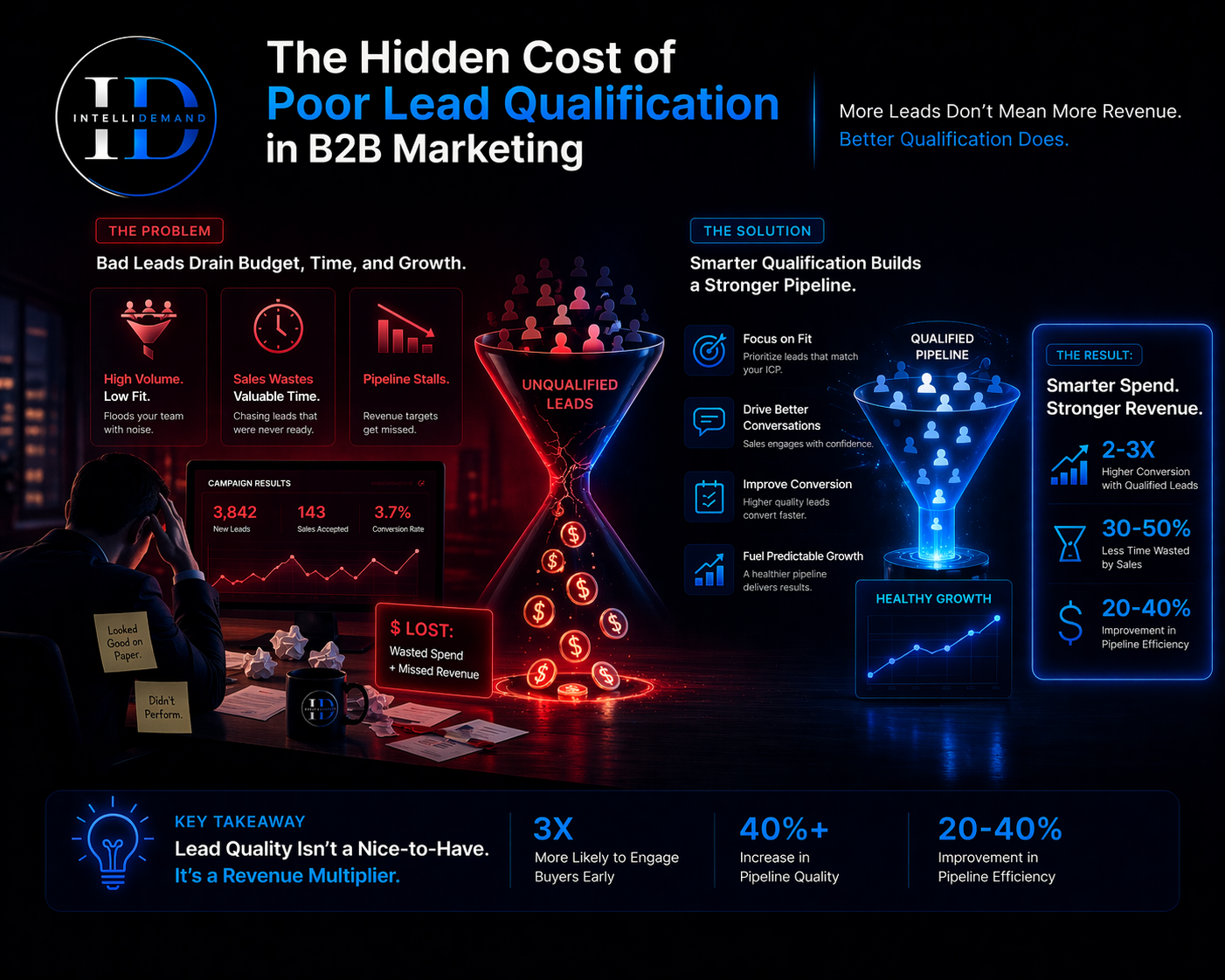
The Hidden Cost of Poor Lead
Qualification in B2B Marketing

Copyright © 2026 IntelliDemand