
Blog
Account-Based Demand Generation:Winning Complex Enterprise Deals
Enterprise B2B sales are not won with broad campaigns.
They are won with precision.
In high-value markets, buying decisions involve:
- Multiple stakeholders
- Long evaluation cycles
- Cross-functional alignment
- Competitive scrutiny
- Executive oversight
Traditional lead generation struggles in this environment.
Because enterprise revenue is not contact-driven.
It is account-driven.
This is where Account-Based Demand Generation (ABDG) becomes a strategic advantage.
Why Enterprise Deals Demand a Different Approach
In mid-market and enterprise segments:
- 6–12 stakeholders influence decisions
- Technical validation is mandatory
- Procurement is involved
- Risk assessment is formal
- Vendor comparison is rigorous
A single whitepaper download does not create momentum.
A single email response does not create pipeline.
Enterprise buying requires coordinated influence across the account.
Account-based demand generation aligns to that reality.
From Lead Volume to Account Momentum
Traditional demand models optimize for:
- Cost per lead
- MQL count
- Individual contact engagement
Account-based models optimize for:
- Account penetration
- Buying committee engagement
- Stakeholder coverage
- Decision-stage progression
The KPI shifts from:
“How many leads?”
To:
“How many target accounts are advancing toward revenue?”
This reframing changes everything.
The Core Pillars of Account-Based Demand
High-performance ABDG programs are built on five pillars.
1️⃣ ICP Precision & Account Tiering
Enterprise success begins with precise targeting.
This includes:
- Industry segmentation
- Revenue band alignment
- Technographic analysis
- Growth indicators
- Strategic fit validation
Accounts are tiered based on:
- Revenue potential
- Strategic importance
- Competitive landscape
- Market influence
Not all accounts deserve the same investment.
Precision prevents waste.
2️⃣ Buying Committee Mapping
Enterprise deals rarely rely on one champion.
High-performing teams identify:
- Economic buyers
- Technical evaluators
- End-user stakeholders
- Procurement influencers
- Executive sponsors
Each role requires tailored messaging.
Ignoring committee dynamics slows pipeline.
3️⃣ Intent-Layered Account Activation
Account-based programs integrate:
✔ Intent signal monitoring
✔ Behavioral tracking
✔ Engagement scoring
✔ Topic-level analysis
Instead of cold outreach, activation aligns with:
Active research behavior
Industry triggers
Competitive exploration
This improves relevance.
Relevance increases response quality.
4️⃣ Multi-Channel Orchestration
Enterprise demand cannot rely on one channel.
Account-based orchestration includes:
- Personalized email sequences
- Account-specific content delivery
- SDR contextual outreach
- Executive-level introductions
- Retargeting campaigns
- Social engagement reinforcement
Each touchpoint reinforces the same value narrative.
Consistency builds trust.
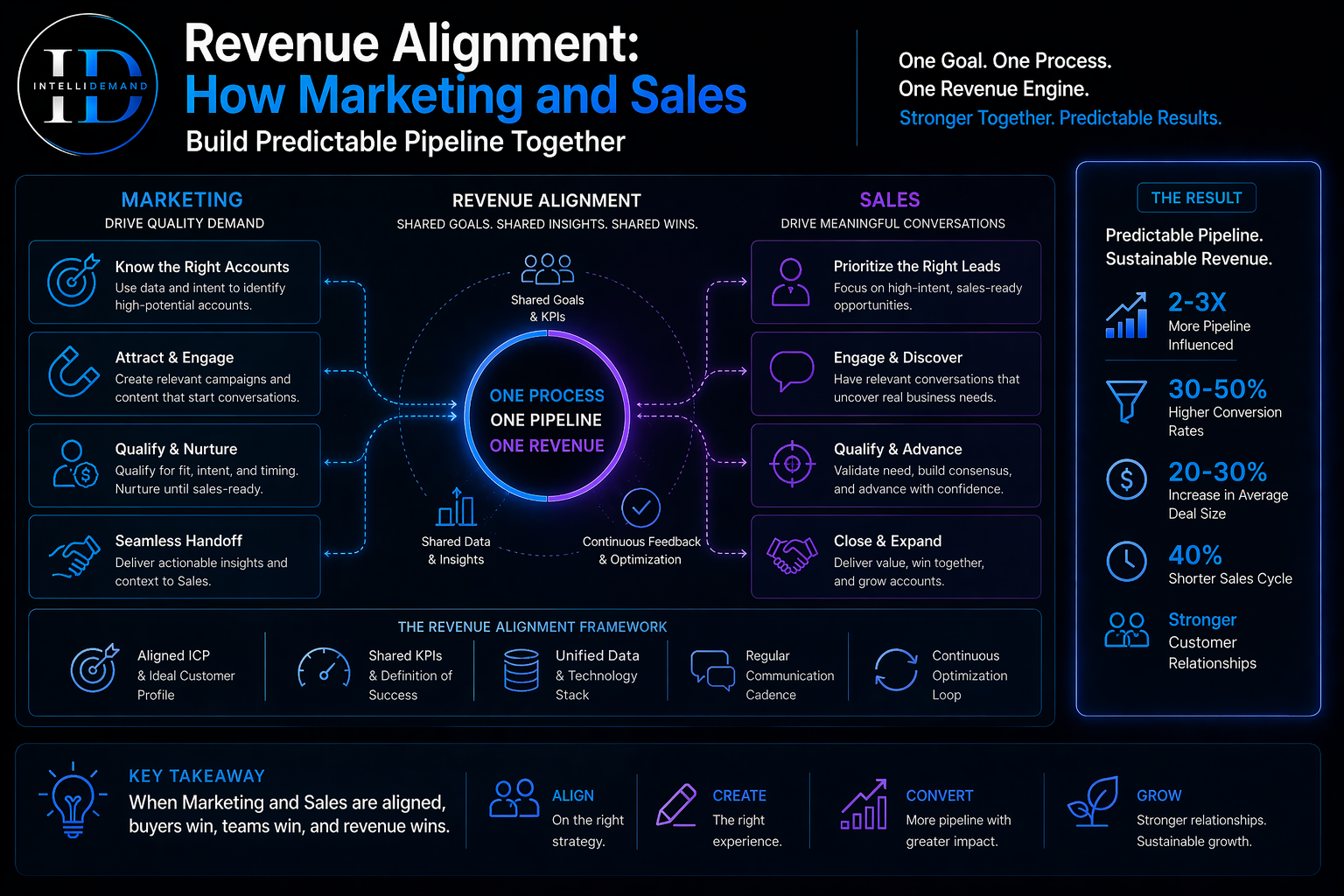
5️⃣ Sales & Marketing Revenue Alignment
Account-based demand only works when:
- Sales and marketing share targeting
- Qualification standards are aligned
- Account plans are coordinated
- Engagement insights are shared
Revenue ownership becomes collective.
Silos disappear.
Pipeline accelerates.
The Enterprise Buying Journey
Enterprise buyers evaluate vendors across stages:
1️⃣ Problem recognition
2️⃣ Solution exploration
3️⃣ Vendor comparison
4️⃣ Risk assessment
5️⃣ Commercial negotiation
Account-based demand aligns messaging to each stage.
Instead of pushing product features prematurely, it:
Educates early
Differentiates mid-stage
Validates late-stage
This structured progression increases win probability.
Why Broad-Based Demand Fails Enterprise
Broad demand programs often:
- Target too widely
- Personalize too little
- Activate too early
- Follow up inconsistently
Enterprise buyers detect generic messaging instantly.
Authority requires depth.
Relevance requires research.
Credibility requires precision.
Account-based demand delivers all three.
Measuring Account-Based Success
Traditional marketing metrics lose relevance.
High-performance teams measure:
- Account engagement depth
- Stakeholder coverage rate
- Intent escalation
- Meeting quality
- Opportunity conversion
- Revenue contribution
Success is defined by:
Pipeline value — not activity.
The Competitive Advantage of Account Focus
In saturated markets, differentiation is critical.
Account-based demand enables:
- Earlier engagement
- Stronger positioning
- Deeper stakeholder influence
- Competitive insulation
Instead of reacting to RFPs, organizations shape evaluation criteria early.
That is influence.
Influence drives revenue.
The Infrastructure Behind Account-Based Growth
Successful ABDG requires:
- Integrated data systems
- Intent monitoring
- CRM alignment
- Marketing automation integration
- SDR collaboration
- Continuous optimization
This is not a campaign tactic.
It is revenue infrastructure.
Final Thought
Enterprise deals are not won through mass outreach.
They are won through coordinated account influence.
Account-based demand generation transforms:
Contacts → Accounts
Engagement → Momentum
Campaigns → Infrastructure
Leads → Revenue
If your growth strategy includes enterprise expansion, account-based demand is no longer optional.
It is essential.

Copyright © 2026 IntelliDemand